
The DFW Soil Struggle: Why Multi-Family Properties in Dallas-Fort Worth Are Uniquely Prone to Foundation Movement
What Apartment Owners and Property Managers in North Texas Need to Know About Expansive Clay and Structural Risk
If you own or manage a multi-family property anywhere in the Dallas-Fort Worth Metroplex, the ground beneath your investment is working against you in ways that most markets never have to contend with. The expansive clay soils that stretch across North Texas are among the most geologically active in the entire country, and the concentrated footprint, shared drainage systems, and loading demands of apartment communities and multifamily developments make them especially vulnerable to the kind of foundation movement that can quietly escalate from a maintenance issue into a costly structural liability.
At Dodson Foundation Repair, we have spent years working with property owners, asset managers, and HOA boards across the DFW area to assess, repair, and protect foundations on properties of every size and age. We understand the specific soil conditions in communities from Frisco and Allen to Arlington, Grand Prairie, and Irving. More importantly, we understand that in the multi-family world, foundation problems carry consequences that extend well beyond repair costs. This is your residents’ home and your bottom line. We take both seriously.
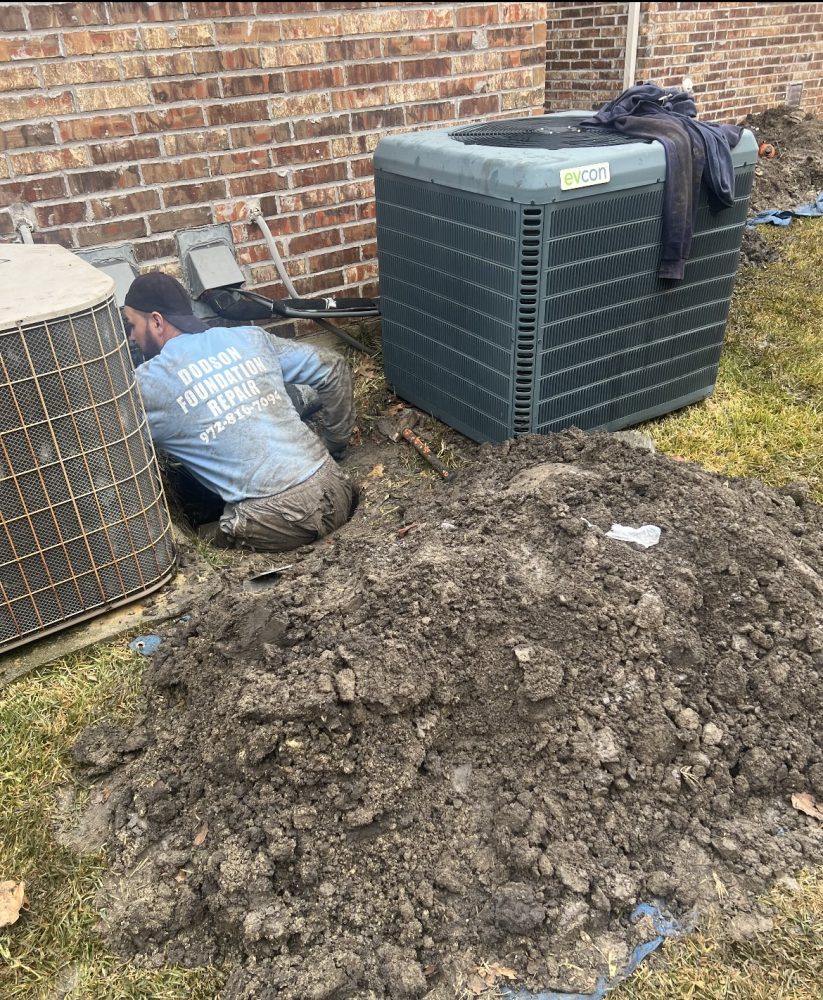
The Soil Beneath DFW Is Not Like Anywhere Else
Most of the Dallas-Fort Worth Metroplex sits on a geological formation known as Blackland Prairie soil, more informally called “black gumbo” clay. This dense, dark clay is extraordinarily reactive to moisture. When rain saturates it, it swells. When a Texas summer bakes it dry, it contracts and pulls away from whatever is resting on top of it. Engineers call this the shrink-swell cycle, and in North Texas, it never really stops.
The numbers behind this movement are striking. In some parts of Dallas, soil volume can shift anywhere from 30% to 75% depending on moisture levels, making it some of the most volatile soil in the world. DFW’s black gumbo soils can generate pressures exceeding 10,000 pounds per square foot on foundations during periods of expansion. And according to a study cited by the American Society of Civil Engineers, expansive soils cause more financial damage to structures in the United States than all other natural disasters combined, with total annual costs exceeding $15 billion.
Compounding this is a more recent challenge: a study by Nature Cities found that more than 70% of land in both Dallas and Fort Worth is sinking at a rate exceeding 3 mm per year, driven in part by groundwater extraction and the sheer weight of urban development. For a region that has added millions of residents and thousands of new structures over the past decade, this long-term subsidence creates an additional layer of movement that property owners rarely account for in their maintenance planning.
Why Multi-Family Properties Face a Bigger Challenge Than Single-Family Homes
Every structure on DFW clay faces foundation pressure, but multi-family properties face it on a scale and complexity that single-family homes do not.
Larger footprints create more differential exposure. A sprawling apartment complex or townhome community sits across a much wider soil area than a single home. That means different sections of the same building can sit on soil with different moisture levels, different clay densities, and different drainage patterns simultaneously. When one part of a structure moves and another does not, the structural stress that results is what engineers call differential settlement, and it is responsible for the stair-step cracks in brick veneer, the sticking doors in Building C while Building A shows no issues at all, and the sloping floors that residents report and management struggles to explain.
Shared plumbing systems are a major hidden risk. Multi-family properties have significantly more underground plumbing running beneath and around their foundations than a typical residence. A slow slab leak or a compromised irrigation line in one part of the property can saturate soil locally, causing that section of foundation to heave upward while surrounding areas remain stable or continue settling. Undetected plumbing leaks can wash away the soil beneath a foundation, creating voids that lead to rapid settlement, and many North Texas properties have underground lines that can go unnoticed for years while slowly damaging the foundation.
Drainage complexity amplifies soil movement. Large paved areas, parking lots, pool decks, and building clusters all affect how water moves across a property after a storm. When drainage is not actively managed, water channels toward foundation edges, saturating soil unevenly. Many established neighborhoods in the DFW area lack the comprehensive drainage systems required by modern building codes, and multi-family properties built before the 1990s are especially likely to have drainage infrastructure that no longer meets current standards or adequately manages the volume of runoff that today’s storm events produce.
Deferred maintenance accelerates the damage. In a multi-family environment, landscape irrigation runs constantly, residents report maintenance issues through layers of communication, and seasonal soil management is rarely part of a formal maintenance program. All of these factors allow the conditions that cause foundation movement to persist far longer than they would on a closely monitored single-family property.
Warning Signs Multi-Family Property Managers Should Never Ignore
Because the scale of a multi-family property can make early warning signs easy to dismiss as isolated maintenance calls, it is worth knowing what patterns signal a foundation problem rather than routine wear:
- Diagonal cracks appearing at the corners of door frames or windows, especially on exterior walls
- Doors or windows in multiple units that stick, bind, or no longer latch correctly
- Stair-step cracking along brick or masonry veneer at the building’s exterior
- Visible separation between the building and attached structures like breezeways, garages, or stairwells
- Sloping or uneven floors reported across more than one unit in the same building
- Cracks in concrete flatwork, including sidewalks, driveways, and pool decks, that appear to follow a consistent directional pattern
- Persistent pooling of water near building foundations after rain
Any one of these in isolation may have a simple explanation. A pattern across a building or cluster of units is a signal to call for a professional foundation assessment before the underlying movement advances further.
What Dodson Foundation Repair Does Differently for Multi-Family Properties
Residential foundation repair and multi-family foundation repair are not the same job. The scope, the coordination requirements, the documentation standards, and the impact on occupied units demand a team that understands the commercial and institutional side of property management, not just the structural side.
At Dodson Foundation Repair, our inspections for multi-family properties are conducted with an eye toward the full picture: soil behavior across the entire site, drainage patterns, plumbing vulnerability, and the cumulative movement history of the structure. We provide written assessments that are clear enough to share with property owners, lenders, and insurance carriers. Our repair recommendations are designed to address root causes rather than surface symptoms, and our team coordinates work schedules to minimize disruption to residents and operations.
We work throughout the DFW Metroplex, including Dallas, Fort Worth, Plano, Irving, Arlington, Garland, McKinney, Frisco, Denton, and surrounding communities, and we understand that no two properties in this region sit on identical soil conditions. That is why every assessment we provide is specific to the site, not a template.
Is your multi-family property showing signs of foundation movement? Do not wait for a maintenance issue to become a structural liability. Contact Dodson Foundation Repair today to schedule a professional site assessment. Our team is ready to give you honest answers and a clear path forward. Call us now or reach out through our website to get started.